Pregnant Mom Line Art: A Designer’s Real-World Embroidery Review
First Impressions: Soft, Sincere, and Surprisingly Versatile
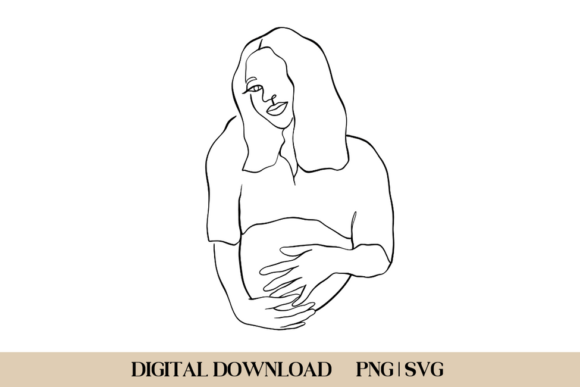
When I opened Pregnant Mom Line Art for the first time, what struck me wasn’t just its simplicity—but its quiet confidence. This isn’t a busy, overly stylized illustration. It’s hand-drawn with gentle, unbroken contours: a side-profile silhouette of a woman cradling her belly, rendered in clean, continuous line work. There’s warmth in the curve of her shoulder, intention in the tilt of her head, and tenderness in the way the line flows into the swell of pregnancy. It feels human—not clinical, not cartoonish, not trend-chasing. That makes it unusually adaptable across embroidery projects, from a boutique baby onesie to a linen tea towel for a midwife’s waiting room.
A Real Project Test: Embroidering a Linen Tote for a Baby Shower Gift
Last week, I used Pregnant Mom Line Art on a natural linen tote—intended as a personalized gift for a friend’s baby shower. I chose a medium-weight cutaway stabilizer and 40-weight cotton thread in soft sage. The result? Crisp, legible stitching at 4.5" wide—no bleeding, no skipped stitches, even across linen’s subtle texture. Because the design relies on contour rather than dense fill or fine interior detail, it translated beautifully without overloading the fabric. Customers notice this subtlety: it reads as thoughtful, not generic. That matters when your handmade product competes with mass-produced prints.
Where It Shines (and Where It Asks for Care)
Pregnant Mom Line Art excels in contexts where clarity, calm, and emotional resonance matter more than flash:
- Custom apparel: Works cleanly on sweatshirt cuffs, t-shirt hems, or back yokes—especially when scaled between 3"–5". Its minimalism avoids overwhelming knit fabrics.
- Baby embroidery: Ideal for onesies, burp cloths, and blanket corners. No tiny facial features to distort under stitching—just serene, scalable shape.
- Nursery decor & boutique merchandise: Looks grounded on pillow covers, framed hoop art, or ceramic mugs (when paired with printable mockups). Its line-art nature invites pairing with soft typography or botanical accents.
- Holiday or milestone gifts: Feels meaningful for baby showers, Mother’s Day, or “welcome to parenthood” keepsakes—without leaning into cliché.
But here’s where attention is needed:
- Small hoop sizes (under 3"): The curvature of the belly and the gentle slope of the neck lose definition below ~2.75". Test stitch before committing to a 2" cap front.
- Stretchy or thin fabrics: On lightweight jersey or ribbed knits, use tear-away + light cutaway stabilizer—and avoid pulling the hoop too tight. The single-line flow can waver if the base shifts.
- Dark or textured backgrounds: While the line works well in black thread on cream, avoid ultra-fuzzy terrycloth or heavily napped fleece—the line may visually “sink.” A satin stitch outline (if adapted) would help, but the original PNG/SVG is pure contour.
- Curved surfaces like caps or hats: The design’s horizontal orientation suits flat panels best. If using on a curved crown, consider slight vertical compression in your embroidery software to preserve proportion.
What It Adds to Your Finished Product—Beyond Aesthetics
As a designer who ships 50+ custom embroidery orders monthly, I pay close attention to how a motif influences perceived value and trust. Pregnant Mom Line Art elevates a simple tote or tea towel because it signals intention—not just decoration. Buyers recognize craftsmanship in restraint. They also respond to authenticity: this isn’t stock clipart repackaged. That builds credibility for your craft business, Etsy shop, or small-batch brand. It supports cohesive branding when paired with neutral palettes and natural materials. And yes—it photographs exceptionally well for social media and digital embroidery file previews, especially in lifestyle flat lays with dried florals or woven baskets.
Practical Notes Every Embroiderer Should Check Before Stitching
This is a digital embroidery file—PNG and SVG—but remember: those formats aren’t machine-ready by default. You’ll need to digitize it (or source a pre-digitized version) for actual stitching. Before launching your next batch of embroidered patches, sweatshirts, or nursery pillows, take these steps:
- Test on scrap fabric that matches your final material—linen, cotton poplin, French terry—especially to gauge how the line holds on weave irregularities.
- Review stitch density if you’re adapting it yourself. Avoid heavy fill stitches; lean into running stitch or satin outlines for fidelity to the original hand-drawn feel.
- Confirm hoop size compatibility for your target product—e.g., a 4" x 4" hoop works for most tote placements, but check cap frames separately.
- Inspect small details at 200% zoom in your embroidery software: ensure the line remains unbroken at the belly’s apex and the hairline’s taper.
- Mock it up in black and white first—this design lives or dies on contrast. If it fades on dark fabric in grayscale, adjust thread weight or add a subtle underlay.
- Verify licensing before selling finished items or bundling it into digital embroidery bundles. Since it’s categorized under Illustrations and Graphics, commercial use may require explicit permission—don’t assume.
Final Thought: Not Just Another Silhouette
Pregnant Mom Line Art stands out because it balances delicacy with durability—visually and functionally. It doesn’t shout. It settles in. That makes it ideal for makers who value quiet impact over visual noise: the Etsy seller curating a mindful baby collection, the apparel decorator building a signature maternity line, or the hobbyist stitching heartfelt gifts that feel personal, not programmed. Use it with intention, test it with care, and let its sincerity do the talking—on fabric, on skin, and in the hands of someone who needs to be seen, gently.